
Attendance
Attendance – Why Good Attendance is Essential

Children are at the heart of our Christian motto – Let Your Light Shine Matthew 5:16
At St James, we believe every child has a light, their own light and with support and nourishment, they will be able to shine. Our shared vision is that our children are happy to come to school, they feel safe and well cared for. They feel challenged and supported in their learning and are excited by their learning opportunities. With this happiness and love of learning, they attend school every day, which in turn brings them academic success and the opportunity to reach their potential. Attending school means that children can make friends, improve their social skills and build positive relationships to prepare them for life. As a school, we maintain that academic success is linked to high attendance and we have high expectations for all of our children to reach their greatest potential.
The Attendance Team led by our Senior Attendance Champion and Deputy Head Teacher, Mrs J Pritchard, supported by our Attendance Officer Mrs Sagoo, our class teachers, pastoral and administration teams take responsibility for monitoring the attendance of children and regularly promote the importance of attendance and punctuality. We aim to achieve at least 95+% attendance each academic year and ensure our persistent absence % is at least in line with national levels if not lower.
The Attendance Team will use attendance data to identify any patterns of concern and look to work with families to identify the barriers to achieving and maintaining excellent attendance and offer the right service at the right time to try to resolve any difficulties. Our aim is to build strong relationships with our families, to ensure that every child registered at the school attends every day and arrives punctually. We will listen to issues around attendance and work with families to remove these so that poor attendance does not become ‘the norm’. Our emphasis is on support before sanctions. Attendance concerns will be raised with parents if reasons are not known by the school. Where we have concerns, or lack of engagement from families to improve attendance, we will follow the Local Authority’s Support First guidance. Early Help is offered, in the first instance, with Mrs Pritchard and/or Mrs Buckle making referrals to outside agencies where appropriate. If attendance does not improve, parents/carers are invited to a Formal Attendance Meeting (FAM) with Mrs Pritchard and Mrs Sagoo where the potential for legal intervention is made clear.
Our aim is to always work in partnership with parents and any referral for legal intervention is deemed to be a last resort at St. James. Throughout the school year, the Deputy Head Teacher will report on the overall attendance figures including those for different groups, monitoring of support which is reported to the Governing Body.
Expectations
We use the following percentages to classify our attendance.
98%+ Excellent
95 – 97% Good
90 – 94% - Concern (poor)
Below 90% - High Concern – officially ‘persistently absent’
Expectations are communicated with parents at the beginning of every academic year and on a regular basis via our newsletters. Attendance figures for each child will be reported to parents as part of their annual report, we will also share a child’s attendance printout with parents/relevant agencies if we have concerns regarding a child’s attendance.
The table below is included in the information shared.
|
Attendance during one school year |
equals this number of days absent |
which is approximately this many weeks ‘absent |
which means this many lessons missed |
|
95% |
9 days |
2 weeks |
50 lessons |
|
90% |
19 days |
4 weeks |
100 lessons |
|
85% |
29 days |
6 weeks |
150 lessons |
|
80% |
38 days |
8 weeks |
200 lessons |
ATTENDANCE IS EVERYONE’S RESPONSIBILITY

|
Our expectation of parents/carers:
|
Our expectation of class teachers:
|
Promoting excellent attendance
The school will employ a wide range of strategies to promote excellent attendance:
- Teachers will regularly communicate with children and parents on attendance matters.
- Clear attendance information will be communicated to parents, staff, children and governors within the Attendance and Punctuality Policy and on the school website.
- Good, regular attendance will be highlighted in the Induction meetings for new parents.
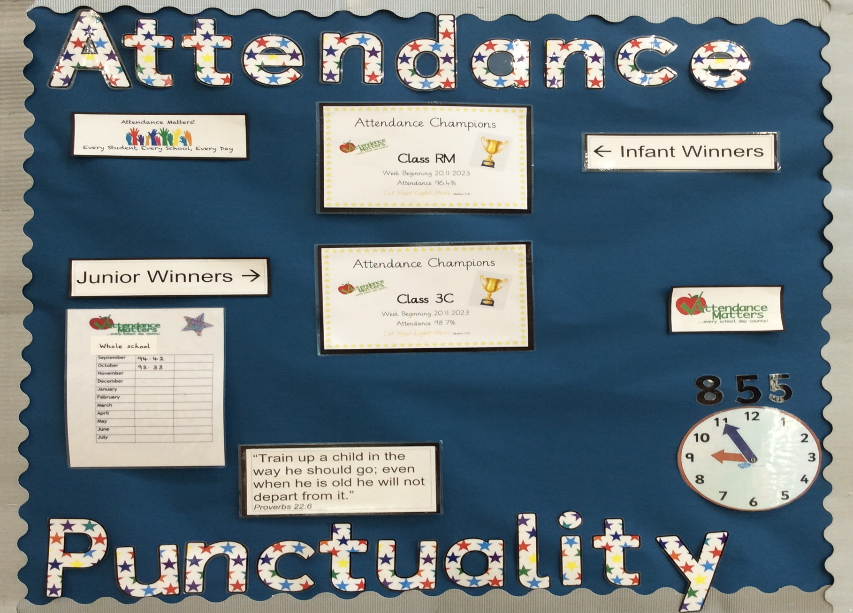
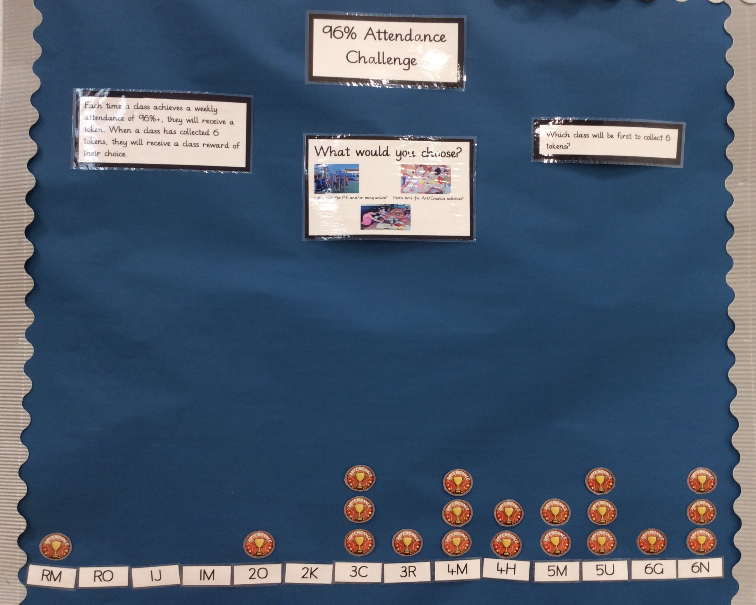
- An Attendance and Punctuality noticeboard is displayed in the school hall. It is changed weekly, highlighting the best attending class in KS1 and KS2 as well as demonstrating progress to the ‘96% Attendance Challenge’.
- Informing parents, staff, children and governors on the school newsletter fortnightly. The school aims to encourage excellent attendance, where the children’s efforts are acknowledged and rewarded. Rewards will be various and may include:
- Termly certificates to individuals with excellent attendance.
- Termly prizes for attendance.
- Attendance Teddy/weekly prize awarded to class who has best attendance in KS1 and KS2.
- Weekly ‘96% Attendance Challenge’ – a class will celebrate their collective success. When a class achieves 96% or above they receive a token. When they have collected 6 tokens, they will receive a class reward of their choice.
- All classes with excellent attendance highlighted and promoted within fortnightly newsletter.
- Certificates/letters for improved attendance.